How big is a degree?
A nanosecond is about a foot, which makes time physical. Coordinates need the same treatment, because a latitude with nine decimal places looks authoritative and most of it is noise.
A degree of latitude is about 111 km anywhere on Earth. A degree of longitude is 111 km at the equator and shrinks with the cosine of latitude — at Chicago it is about 82.8 km. Every decimal place after that divides by ten.
The ladder
| Digits | Step | Δ lat | Δ lon (Chicago) | Light-time | Scale |
|---|---|---|---|---|---|
| 0 | 1° | 111 km | 82.8 km | 371 µs | state / country |
| 1 | 0.1° | 11.1 km | 8.28 km | 37.1 µs | city |
| 2 | 0.01° | 1.11 km | 828 m | 3.71 µs | neighborhood |
| 3 | 10⁻³° | 111 m | 82.8 m | 371 ns | city block |
| 4 | 10⁻⁴° | 11.1 m | 8.28 m | 37.1 ns | building |
| 5 | 10⁻⁵° | 1.11 m | 828 mm | 3.71 ns | room |
| 6 | 10⁻⁶° | 111 mm | 82.8 mm | 371 ps | hand |
| 7 | 10⁻⁷° | 11.1 mm | 8.28 mm | 37.1 ps | fingernail |
| 8 | 10⁻⁸° | 1.11 mm | 828 µm | 3.71 ps | pencil tip |
| 9 | 10⁻⁹° | 111 µm | 82.8 µm | 371 fs | hair width |
| 10 | 10⁻¹⁰° | 11.1 µm | 8.28 µm | 37.1 fs | red blood cell |
| 11 | 10⁻¹¹° | 1.11 µm | 828 nm | 3.71 fs | near-infrared wavelength |
| 12 | 10⁻¹²° | 111 nm | 82.8 nm | 371 as | virus |
| 13 | 10⁻¹³° | 11.1 nm | 8.28 nm | 37.1 as | small protein |
| 14 | 10⁻¹⁴° | 1.11 nm | 828 pm | 3.71 as | DNA helix width |
| 15 | 10⁻¹⁵° | 111 pm | 82.8 pm | 371 zs | single atom |
The light-time column is the point of putting this on a timekeeping site: it is how much clock error that much position error is worth, using the same foot-per-nanosecond conversion.
Where the digits stop being real
Three thresholds worth knowing, because they mark where extra digits change from information into decoration:
- Six decimal places — about 10 cm. The practical sweet spot for centimeter-class navigation. This is as far as most people ever need to go.
- Eight decimal places — about 1 mm. Roughly the limit of a clean PPP-AR solution with 24 hours of observations. Getting here is real work.
- Beyond nine — under 100 µm. Past the actual physical stability of any antenna mount. Thermal expansion of the mast moves the antenna further than this between morning and afternoon.
Software will happily print fifteen decimal places, and the last six of them describe a position smaller than the daily flex of the pole the antenna is bolted to. A coordinate is only as good as the thing holding it still.
What it is worth in time
Read the light-time column against the accuracy you are chasing:
- Getting position to a building (4 digits) leaves ~37 ns on the table — already too coarse if you care about UTC to better than that.
- Getting it to a room (5 digits) is 3.7 ns — fine for most datacenter work.
- Getting it to a hand (6 digits) is 371 ps, and at that point your feedline and your survey method dominate by a wide margin.
Which is the useful takeaway: past about six decimal places, position stops being your limiting error and something else takes over. See configuring antenna position for what that something else usually is.
The obligatory reference
Randall Munroe made this point faster than the table above does, and better:
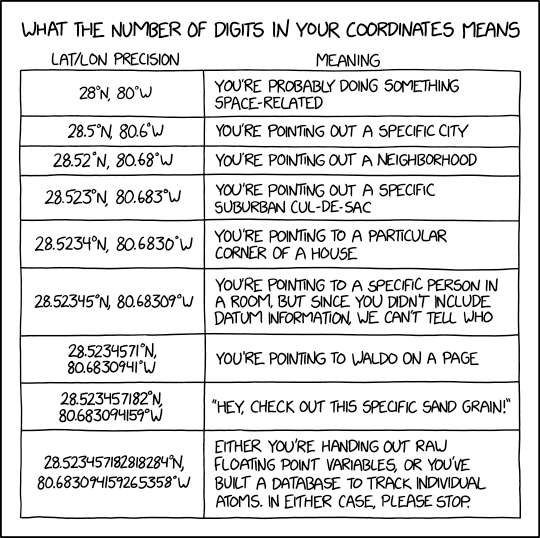
“Coordinate Precision” by Randall Munroe, xkcd. Used under CC BY-NC 2.5; see the xkcd license. Hover the image for the title text, which is the better half of the joke.
The ladder above is the same observation with the numbers filled in — and with the light-time column, which is the part that matters if what you are really building is a clock.