Sub-Nanosecond at Home, Take Four
I gave this talk again today, on the Time Appliances Project call — a month after the first outing at NPL, and to a room full of the people who actually run datacenter time for a living. Same argument, same parts list, same clock. Four more slides.
What is interesting is where those four came from. I spent the month between the two versions writing Topics In Timekeeping — thirty pages on the material the talk has to skate over — and the new slides are almost entirely things I only understood well enough to draw because I had to write them down properly first.
I must credit my friend Prof David Lariviere for his critical review of the London NPL presentation. His pointed questions steered the content I created for the timekeeping pages and the additions to the presentation.
Explaining it to David 1:1 turned out to be a better way to find the holes than explaining it to a room. A room is polite about the parts you hand-wave.
What is new
Three pictures of the same satellite, in order of how wrong they are. The intuitive model has master clocks in orbit. The next one has the ground steering them. The real one has the satellites free-running while the ground computes corrections and the satellite relays them — and your receiver does the arithmetic. That progression is the spine of what limits GNSS time accuracy and I could not have drawn it cleanly before writing that page.
What a correction stream actually buys. Leaving the broadcast navigation message for a real-time stream is a factor of 25 in error and a factor of 100 in freshness, in one step. Two numbers on a slide that used to be a paragraph of arm-waving.
A very expensive thermometer. Eight minutes of quantization error from a u-blox F9T while my lab warmed and cooled — probably a ceiling fan on a warm afternoon. The sawtooth sweeps one way, slows, stops, and reverses. Unwrapped, the oscillator’s phase walked out to 120 ns and came back. When you compare GPS time to quartz time, you have built a thermometer. That slide is now the evidence on how GNSS holdover works, because in holdover nothing is watching that happen.
A trading campus that agrees with itself much better than it agrees with UTC. Any pair of ports across a half-mile Equinix campus in Secaucus syncs to 200 ps, while the same equipment holds only ±15 ns RMS to UTC. That is a factor of seventy-five, it is the normal state of affairs, and for most of what those machines compute it is the right trade — which is the whole of agreement versus accuracy.
And one honest new result
The clock reaches sub-nanosecond stability and still only manages 3 ns of agreement between clocks.
Those are not in tension, they are the two different ways of being wrong that this subject keeps insisting on. Stability says the output is quiet. Agreement says two of them land in the same place. The carrier-phase measurement underneath is doing extraordinarily well — 37 to 109 ps of per-epoch precision, which is the number I keep pointing at — and the gap between that and 3 ns is the work that remains.
Saying so on a slide is more useful than saying “sub-nanosecond” and stopping.
The last slide is a QR code
The talk now ends by pointing at Datacenter GNSS Time Best Practices, which is the closing slide of my previous talk unpacked into a page that has room for the reasoning. Eight practices, most of which cost nothing but attention.
That is the shape this has settled into: the talks raise the questions, and the pages are where the answers get written down and corrected.
The slides, and the recording
Watch the talk — the Time Appliances Project published the whole call, and this is the v4 deck with the narration that carries it.
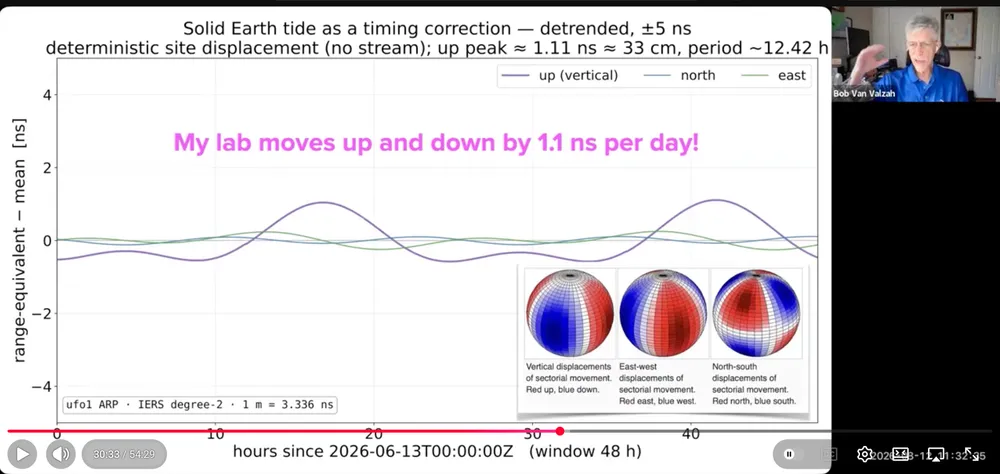
Thirty minutes in, on the slide I did not expect to be arguing about: the solid Earth tide moves my lab up and down by about 33 cm, which is 1.1 ns of range twice a day, and it is deterministic enough to correct for. Click through for the whole 54 minutes.
View the presentation on GitHub, or download it for offline viewing.
There is also a dress rehearsal recording of the July version, kept for the record — it predates the four slides above, and everything else in it stands.
As always the slides are heavy on visuals and light on bullets, so the PDF leaves out what the narration carried. Increasingly, though, what the narration carried is written down properly next door.